Grand Theft Auto 6 launched and the numbers split immediately. Critics awarded the game a 99 Metascore on Metacritic from more than 150 reviews, tying The Legend of Zelda: Ocarina of Time for the highest score in the site's history. Players saw something different. The user score dropped to around 4.9 to 5.3 within the first day, based on thousands of ratings, and Metacritic labeled it Mixed or Average.
This gap is not subtle. One side called it a generational masterpiece. The other side said the game failed to deliver the sandbox chaos that defined the series.

What Players Are Actually Saying
The most common complaint across negative user reviews is simple: this is not GTA. Players describe the experience as closer to Red Dead Redemption 2 or a slow RPG than the open-world crime sandbox they expected. Specific issues keep repeating:
- Morality system that punishes killing pedestrians by labeling the character irredeemable, which then affects story options and weakens abilities like Focus.
- A boring story with unlikable leads.
- An empty map and slow missions that feel more like chores than crime.
- Heavy relationship mechanics that many call a boyfriend simulator, with tasks involving groceries, flowers, and domestic errands.
- Technical problems including a locked 30 frames per second, bugs, a 200GB-plus install, and an $80 price tag.
- No PC version at launch, plus boxed copies that contain only a download code instead of a disc.
Some reviewers gave it a zero solely because the game skipped PC or because a promoted activity turned out to be a short quick-time event. Others openly admitted they had not finished the game yet. A portion of the zeros also look like pure review bombing, with one-line posts attacking the game for political reasons or for not being a perfect 100. Even accounting for that noise, the volume of detailed negative feedback from people who bought and played it is hard to ignore.
The Familiar Pattern of High Critic Scores and Low Player Scores
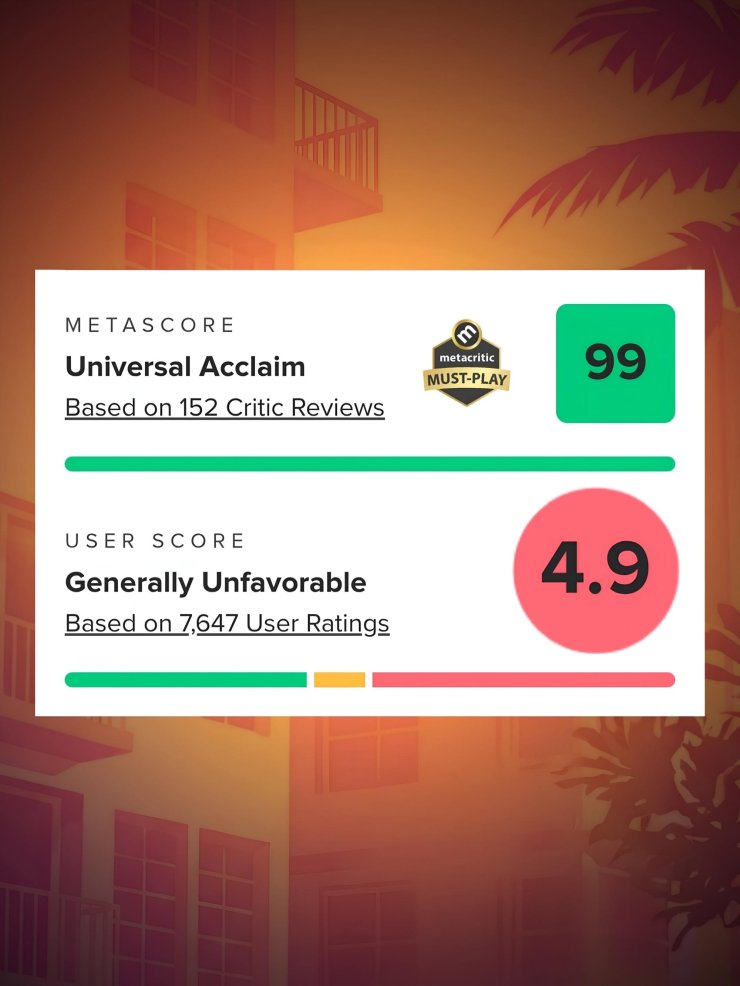
Every time a major release shows this exact split, the same explanation surfaces among players. Studios buy favorable coverage from gaming journalists. The critic side stays almost uniformly positive while the people who spent their own money report a different product. GTA 6 fits the pattern cleanly. Over 150 critic reviews produced a 99 with virtually no mixed or negative scores. Thousands of player ratings produced a score that sits near the middle of the scale and leans negative.
Critics praised the world detail, the production values, and the story partnership between Jason and Lucia. Players focused on restricted chaos, forced relationship tasks, technical limits, and a map that does not support the freeform mayhem the series built its reputation on. Those are gameplay and design complaints, not abstract culture-war slogans. When the people who pay for the game and the people who receive review codes disagree this sharply, the incentive structure becomes the obvious question.
Sales Do Not Erase the Feedback
Strong launch sales do not cancel the player score. Early estimates put first-day sales in the tens of millions, which is expected for a title with this level of anticipation after a 13-year wait. Sales measure hype and pre-orders. Metacritic user scores measure what people think after they actually play. The two numbers can both be true at the same time.
The critic score of 99 will be the number that appears in marketing for years. The player score that settled near 5 will be the number that future buyers check when they want to know whether the game matches the series they already own. The gap itself is the story. When the professional review apparatus and the paying audience land this far apart, the old suspicion returns: the high scores were purchased, and the players who bought the game are the ones left to discover the difference.








Comments