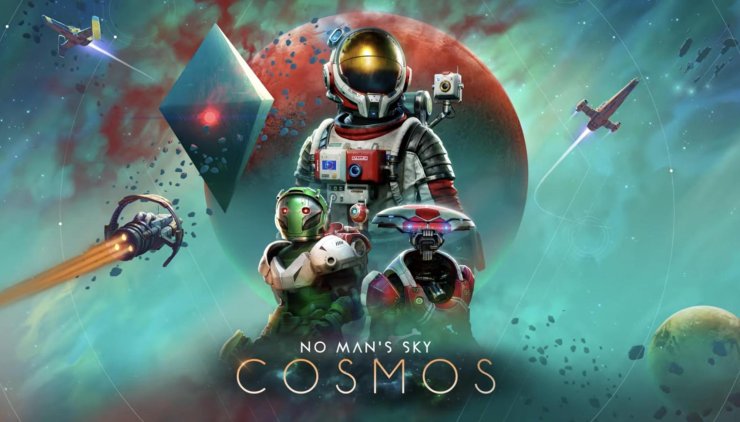
Cosmos, also known as Update 7.0, is a free overhaul of space in No Man's Sky. It launched on September 9, 2026 for existing players on PC, PlayStation 4 and 5, Xbox One and Series X/S, Nintendo Switch 1 and 2, Mac, PSVR 1 and 2, PC VR, and Xbox Game Pass.
For a game everyone still calls a space game, that is overdue. Planets, creatures, bases, settlements, and fleets kept growing for ten years. The void between them stayed mostly the same: a pretty corridor on the way to the next world. Founder Sean Murray said space is a huge part of No Man's Sky, but space itself had barely changed since launch. Cosmos tries to make the void feel alive, then make it feel like home.
A map for the system you are in
Warp into a system and the first useful move is often a scan. The new Star Map works at the local level, separate from the galactic map. It plots planets, the space station, asteroid belts, hulks, outposts, debris fields, and unidentified signals. Mark a point of interest and your ship helps you fly there.
Points of interest start appearing after a save has reached the Space Anomaly. A short tutorial mission called Signals introduces the loop. Space used to be something you crossed. Now it is something you survey.
Hulks, belts, and places that fight back
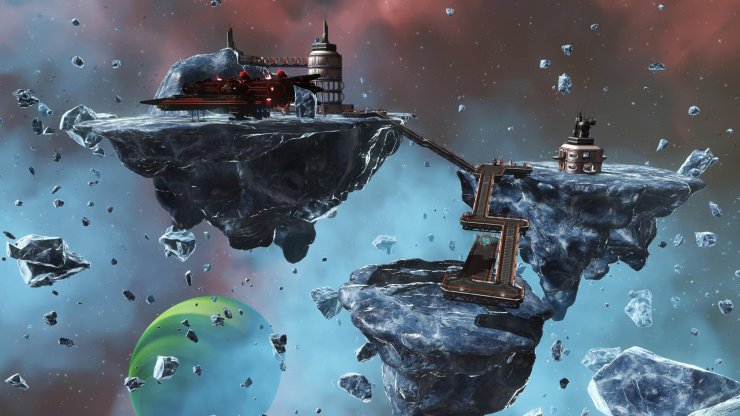
The miles between planets are no longer empty.
Space hulks are colossal derelicts. You spacewalk through rusted chambers, strip cargo and technology, then haul pieces with a physics gravity gun into a new tractor beam on your ship. Tear too much from a wreck and it can melt down and explode. Scanning for the highest-value loot first is the smart play. Volumetric fog and a dedicated music cue mark the moment a hulk starts to fail.
Asteroid belts of rock and ice hold crystals, comet dust, and other materials. Some rare asteroids are large enough to land on. A few are large enough to build on.
Deep-space outposts give those finds a destination. Alien quartermasters trade maps and salvage. A salvage and delivery terminal hands out contracts. Some outposts are infested. Clearing them takes a Gravitino Coil and a willingness to harvest pathogen sacs and gelatinous fibres.
The new loop is simple: find a signal, decide if it is worth the risk, strip it, haul the haul, then sell or build with it.
Own the station. Build in the void.
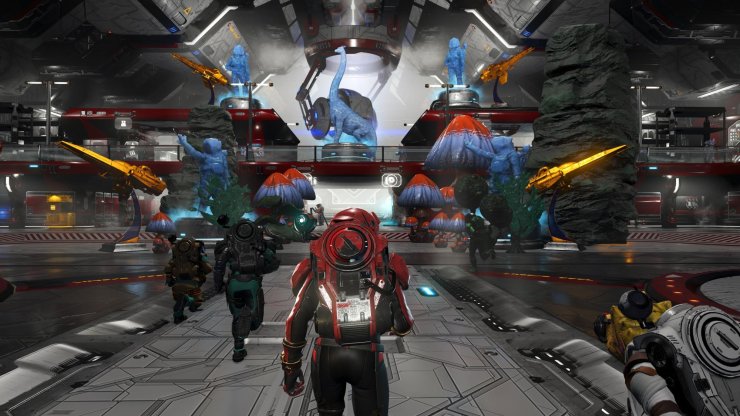
Hello Games calls space station ownership the most requested feature since launch. After you prove yourself to local authorities, you can become director of a system's station. Style the central lobby, add rooms off the hangar, rearrange furnishings, and decorate the exterior with parts unlocked at the Space Anomaly, plus rare pieces found at deep-space anomalies. Friends can visit. The station can be a clubhouse, a themed port, or the flagship of something larger.
You can also live off-world without owning a station. Deploy a deep-space base computer and claim a volume of empty space. Free-floating modular bases can sit anywhere: a truck stop for starships, an orbital restaurant, a military post, or a quiet perch with a planet filling the window. New corridor parts help those structures feel connected. You can also nest a base on a natural asteroid platform and use the rock as terrain.
Alliances
A station can stay personal, or it can become the seed of an alliance. Directors can found a group, name it, and design a banner. Other players join by visiting an owned station. You can belong to up to three alliances. Teleporters make the network easy to move through. Rankings at the station core track the largest, most active, and most expansive collectives.
Yes, you can fly to the sun
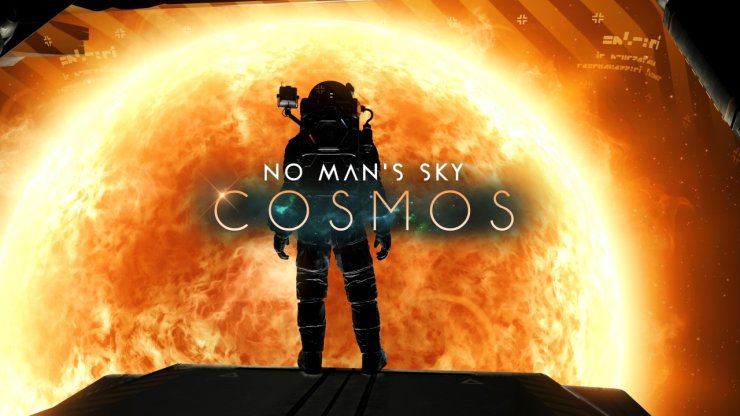
Stars in each system are now reachable by long-haul flight. They are bright, spectacular, and lethal. Reach the sun at your own risk. For the first time since 2016, the center of a system is a destination instead of a painted backdrop.
Our Journey Continues
The limited-time expedition Our Journey Continues treats ten years of updates as a playable museum. Each milestone corresponds to one of the major updates since 2016, more than forty of them. Gameplay nods to the feature that update introduced. Developer notes sit beside it, with commentary from Sean Murray that stays in the Catalogue after you unlock it. The expedition is slated to run about six weeks.
Rewards lean into nostalgia:
- framed commemorative art from old update covers
- titles and decals
- a golden Rasamama S36
- the Starbound v0.27 multi-tool, drawn from early concept art
- a vintage Interceptor rebuilt from pre-release trailer footage
- an astronaut bobblehead
- a diplodocus companion resurrected from old footage, then retextured and reanimated
Around the edges
Cosmos also adds new station decoration parts, new music for deep space, improved terrain on orbital platforms, ice fields, and volumetric lighting that Hello Games is also using as a testbed for Light No Fire.
The long recovery, written in stars
No Man's Sky's reputation was once a punchline. The recovery is now longer than the original controversy. Cosmos does not pretend the early game was finished. It treats space as the last major room that never got furnished, then fills it with salvage, politics, architecture, and one very bad idea involving a star.
Whether station empires and exploding hulks become the new endgame will take weeks of player time to answer. The intent is already clear. After ten years of adding worlds, Hello Games finally added the space between them.






Comments