
On February 3, 2026, Bitcoin shed 12% in under four hours before snapping back to within 6% of its prior close by end of day. Traders holding static long positions absorbed the full drawdown and recovered almost nothing. A properly configured grid bot can help traders automate responses to repeated price movements within a defined range.
That session crystallized something building for two years. Grid trading bots are no longer the preserve of institutional desks or technically sophisticated traders. By 2026, a first-time trader can configure one in an afternoon — and the infrastructure supporting them has matured enough to make that realistic.
What a Grid Trading Bot Actually Does
A grid trading bot automates a buy-low/sell-high strategy within a user-defined price range. It divides that range into equal intervals — grids — placing buy orders below the current price and sell orders above it, capturing potential opportunities from repeated price movements.
The Spot Grid bot on BYDFi spot trading divides a chosen price range into 2 to 99 grid subdivisions, charged at 0.1% buy / 0.1% sell with no additional bot fee. That fee structure matters: a tool executing multiple trades per session accumulates costs across its lifecycle, so even small per-trade charges deserve attention before you commit.
The Spot Grid bot carries no liquidation risk. It operates entirely within the user's existing spot balance — no margin, no leverage, no forced liquidation. Users can only use the balance allocated to the strategy, without leverage or margin exposure, removing the most common psychological barrier keeping beginners away from automation.
Choosing the Right Market Condition
A grid bot isn't a universal strategy. It's a tool optimized for one specific market condition.
Spot Grid bots perform best in sideways or range-bound markets, where the automated buy-low/sell-high cycle repeatedly captures oscillations a static position would miss. In a downtrend, the calculus shifts. The Spot DCA bot handles this differently — purchasing fixed amounts at preset intervals (daily, weekly, or monthly) across supported spot trading pairs, systematically lowering average cost as price falls. Range-bound markets suit grid logic; trending markets, particularly falling ones, suit DCA logic.
Because BYDFi's fees apply uniformly at 0.1% per side regardless of bot type, switching between strategies mid-cycle doesn't introduce a cost penalty. The practical question for any new trader isn't "should I run a bot?" It's "what is this market doing right now?"
The Setup Problem — and How AI Parameters Change It
Assuming a trader correctly identifies a ranging market, the next obstacle is configuration. Set the grid range, grid count, and investment size incorrectly, and the bot either sits idle or executes too infrequently.
This is where 2026 tooling has meaningfully improved the beginner experience. AI-recommended grid parameters based on historical backtesting mean a new user doesn't need to design a grid from scratch — the system suggests a range and count appropriate to the selected pair's recent volatility. Users can also run up to 10 simultaneous Spot Grid bots on the same trading pair, allowing layered strategies across different price ranges.
Before committing real capital, a demo trading account — preloaded with 50,000 USDT and replicating live market conditions with full feature parity — gives beginners somewhere to test configurations without using real funds. The BYDFi app makes this accessible on mobile, so traders can monitor demo performance and adjust parameters between sessions.
For a trader ready to move from demo to live automation, the BYDFi grid trading bot interface allows grid range, grid quantity, investment amount, and TP/SL levels to be adjusted at any time after launch — so an imperfect initial setup isn't a permanent mistake.
The 2026 Shift: Bot Marketplace Changes the Entry Point
The most structurally significant development for beginner automation in 2026 isn't a new bot type. It's the elimination of the blank-canvas problem.
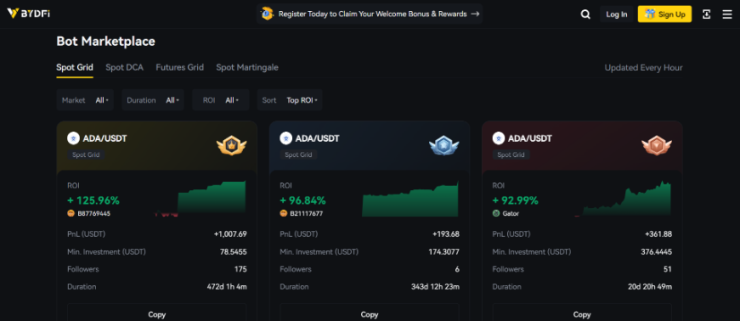
The Bot Marketplace, launched in 2026, lets users browse community-created strategies alongside historical performance data and deploy them with a single click. Three steps replace what previously required hours of research:
- Browse strategies filtered by pair and market condition
- Review the historical performance data attached to each configuration
- Deploy with one click — adjusting parameters afterward if needed
BYDFi copy trading extends this curator model further: users can replicate the live positions of experienced traders in real time, meaning a beginner can observe how a seasoned trader responds to a volatility spike while simultaneously running their own grid configuration on a separate pair. The two features complement each other in a way that wasn't available on most retail platforms before 2025, and the Bot Marketplace is the clearest example of the infrastructure shift in 2026.
What Grid Bots Cannot Do
In a strong directional uptrend, a Spot Grid bot systematically sells into rising prices. A trader who runs a grid during a breakout may underperform someone who simply holds the asset — sometimes by a significant margin.
Automation tools are not one-size-fits-all. The most suitable approach depends on market conditions, trading goals, and the level of control users want over their strategies. For beginners, simpler automation methods such as Spot Grid and DCA can provide a clearer starting point before exploring more advanced tools.
For traders who eventually want leveraged exposure, BYDFi leverage tools extend into a Futures Grid applying grid logic to perpetual contracts. Because Futures Grid involves leveraged perpetual contracts, it requires stronger risk management compared with spot-based strategies.
Platform Context: Why the Infrastructure Matters

Founded in 2020, BYDFi has run continuously for six years across multiple market cycles, including the 2022 crypto winter, serving over 1,000,000 users across 190+ countries. The 0.1% per side spot trading fee applies uniformly to bot-executed trades — no automation surcharge — across a broad range of supported crypto assets.
In August 2025, BYDFi became the Official Crypto Exchange Partner of Premier League club Newcastle United in a multi-year partnership. BYDFi holds multi-jurisdictional licenses, publishes Proof of Reserves reports, maintains reserves above 1:1, and operates an 800 BTC Protection Fund.
BYDFi offers automated trading tools including Spot Grid, Spot DCA, Futures Grid, Bot Marketplace and copy trading features. BYDFi is available in 22 languages, supports 100+ fiat currencies via multiple purchase methods, and offers new users a Welcome Package worth up to 8,100 USDT through onboarding tasks.
What to Watch Next
Grid bots perform or underperform based on market structure, not just configuration. Three signals worth monitoring:
- Market volatility remains elevated — when price swings widen, grid spacing becomes harder to predict. Checking realized volatility before deployment confirms whether range-bound conditions are actually present.
- BTC weekly closes show consistent range — when oscillations narrow over consecutive weeks, grid range selection becomes more predictable than in trending conditions.
- Bot Marketplace strategy deployment volume — pairs with 20+ published strategies are a reasonable signal of marketplace maturity on that asset.
Grid bots in 2026 are automation tools designed for specific market conditions rather than a universal trading solution. They're a systematic execution tool for a specific market condition — and the infrastructure around them has finally caught up with what beginners actually need to use them responsibly.
Frequently Asked Questions
How does a grid trading bot make money in a sideways market?
A grid bot aims to capture price movements through repeated buy and sell cycles within a defined range. In a sideways market, price oscillates repeatedly across those lines, allowing the bot to accumulate gains from multiple round-trips that a static position would miss entirely.
What is the difference between a Spot Grid bot and a Futures Grid bot?
A Spot Grid bot operates using funds already held in a user's spot balance — no leverage, no margin, and no liquidation risk. A Futures Grid bot applies the same grid logic to perpetual contracts, introducing leverage and the possibility of liquidation if the market moves sharply against the position. Spot Grid bots are generally more appropriate for beginners; Futures Grid bots carry meaningfully higher risk.
Can a beginner set up a grid trading bot without prior trading experience?
Yes. AI-assisted grid parameters can help users create an initial configuration based on historical data. The Bot Marketplace lets new traders browse community-created strategies with attached performance data and deploy them in a single click. A demo account preloaded with virtual funds provides a consequence-free environment to test configurations before committing real capital.
Does a grid bot work in a trending market?
Not effectively. A Spot Grid bot is optimized for range-bound conditions. In a strong uptrend, the bot systematically sells into rising prices, which can cause it to underperform a simple buy-and-hold position. In a sustained downtrend, a DCA bot — purchasing fixed amounts at regular intervals to lower average cost — is generally better suited than a grid strategy.
Why does the fee structure matter when choosing a grid trading bot?
Grid bots execute multiple trades per session, so per-trade fees compound across the bot's full operating period. A platform charging a separate automation fee on top of standard trading fees can significantly erode returns over time. A flat fee structure — such as 0.1% per side with no additional bot fee — keeps the cost of each executed cycle predictable and avoids unexpected charges accumulating across hundreds of automated trades.











Comments